From the beginning we said the forest is the therapist, and the guide opens the doors. You’ve likely seen that quote. It came from me. My aim in saying this was to clearly differentiate the role of guide from that of therapist. That sentence served us; it also said slightly too much and slightly too little. Too much, because the forest doesn’t practice therapy — clinicians do, and now many have trained with us. Too little, because it cast the forest as a provider of services, when what we’ve learned is that it’s a partner in relationship. What we understand now is this:
The forest is the landscape of discovery — a landscape of threshold invitations.
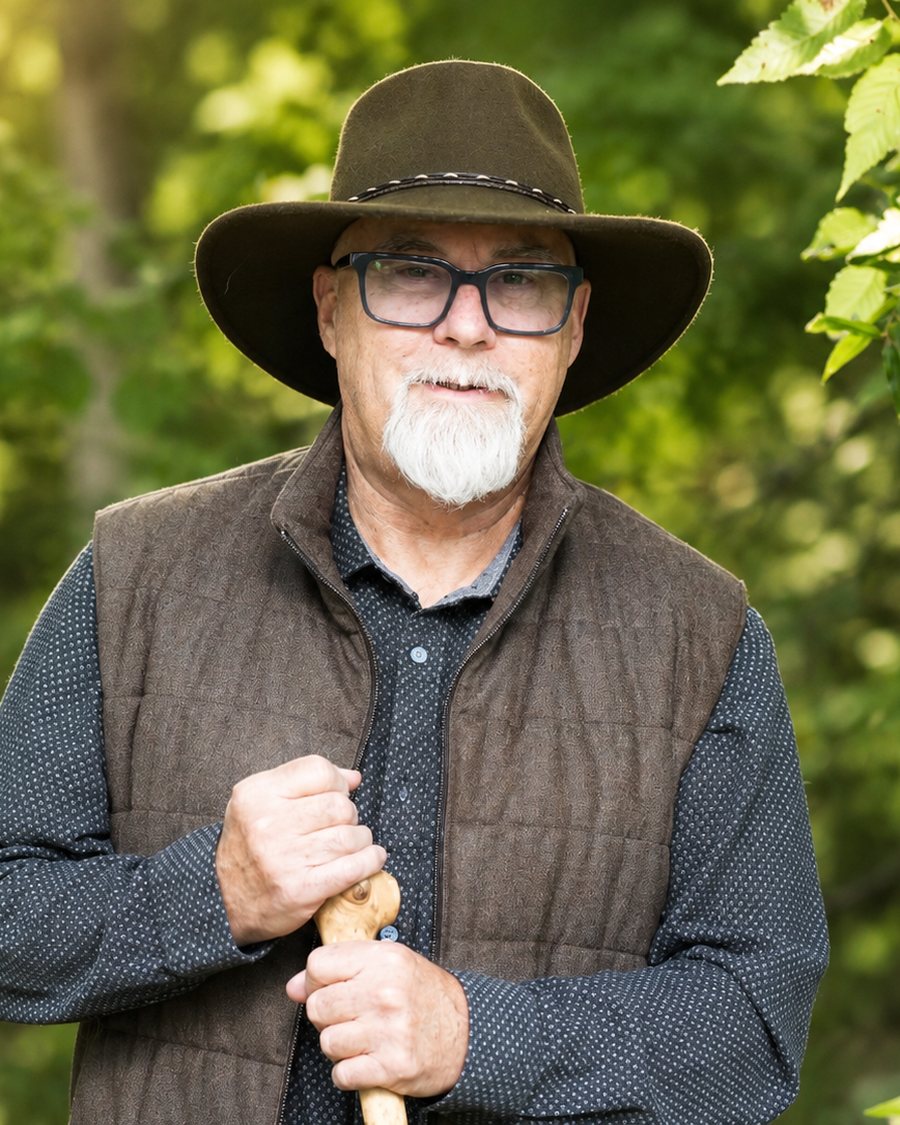
Amos Clifford, Founder
A Living System
ANFT is an unusual school with a kaleidoscopic tapestry of students. And it is more. It is something that has grown — more or less organically, over more than a decade — out of the interaction of many hands, many places, and one shared practice. This page describes what has grown. None of it is aspiration; all of it is already here.
“The forest will always offer an opportunity to connect — with nature, with each other, and with ourselves and our life experiences.”
What has grown
Since the first cohort walked together in 2014, more than 3,150 ANFT-certified guides (as of June 2026, with more joining each month) have taken this practice into forests on every continent except Antarctica, into clinical settings worldwide, and into creative adaptations to hundreds of unique locales and cultures. The cohorts themselves carry names — Komorebi, Cedar, Sea Otter — and numbers now deep into the hundreds, a lineage each guide belongs to permanently. Guides do not simply receive a curriculum; they create new invitations, adapt the practice to their own cultures and landscapes, and return what they learn to a shared body of knowledge that every later cohort inherits.
Around the guiding practice, other forms of contribution took root. Trained consultants now work with land stewards to certify forest therapy trails, spaces, and places — a growing registry of lands, across continents, in formal relationship with this work. Health care professionals carry the practice into clinics through Nature as Medicine. Practitioners and organizations bring offerings of their own through partnership. Walks are guided, and reported, and those reports accumulate into a record of what happens when people and places meet with attention.
No central office produced this. The organization’s role has been to hold the standard, tend the commons, and open the doors — and through those doors, people and places have built the rest.
How the system sustains itself
Each contribution enriches what every other member draws from. A guide’s new invitation, shared with the community, becomes part of the practice a cohort in another hemisphere learns next year. A newly certified trail gives every nearby guide a place to work, and gives its stewards a global community of practitioners who will care for it. A clinician’s outcomes strengthen the case that opens institutional doors for everyone. The directory that helps the public find a guide is made valuable by every guide in it — and makes every guide in it easier to find. This is what it means to say the benefits co-emerge: they are not delivered from the center outward, but arise between the members, the practice, and the land.
“When I guide groups, I notice how quickly I connect with people in nature — we find so much in common without talking much, just by sharing time and insight in the forest.”
A guide and the land belong to each other.
From the beginning, this community’s motto has made an unusual claim: the Forest is the Therapist; the Guide opens the Doors. Taken seriously — and we take it seriously — that means the land is not the venue for this work but a participant in it. The healing that happens on a walk is the land’s contribution. The character of each certified trail is authored by the place itself and merely recognized by the certification. The venues that hold our immersions are in long-term relationship with us, not under contract to us. What the land gives, the system owes back: care, reciprocity, and standing. That obligation shapes how this organization intends to grow.
Open Doors: Forest Thresholds
A living system has many entrances, and no single correct one. Some arrive wanting to guide; some arrive as physicians or therapists; some arrive holding responsibility for a piece of land; some arrive with a work of their own that wants making; some arrive with an offering to bring. The five academies are five doors into the same commons — and the Forest Threshold is the ground they all open onto. Whichever door you enter, you are not enrolling in a program. You are taking a place in something alive, which will be different because you are in it.